
“I know of no part of the body that equals the fascia as a hunting ground.
I believe that more rich golden thoughts will appear to the mind’s eye as the study of fascia is pursued than of any other division of the body“.
-Andrew Taylor Still* (1828-1917) *the OG Osteopath*

Last year, I received more than 60 hours of myofascial release (MFR) training. In these seminars, the fascial system was presented as a component of the body that has many functions, but is often overlooked. In seeking to understand other tissues (muscles, organs, bones, etc.), the stuff that holds it all together gets discarded. Fascia does not show-up on current imaging test like x-rays, MRIs, or CT scans. It can exert up to 2,000 pounds of pressure in a singe square inch of tissue when it is in a state of strain. It is literally everywhere. As such, I found identifying the dura around brain and spinal cord as a type of fascia particularly insightful.
Myofascial release techniques have been utilized for more than a century. Many of the techniques draw from osteopathic holds and movements. Fascia is a strong, pliable network primarily made up of collagen and elastin fibers. It serves many purposes; structure for the liquid-crystalline ground substance flowing through our tissues, wrappings for all varieties of tissue (like muscles, bones, and nerves), making compartments for distinct tissue (like organs and blood vessels), and biokinetic integration; to name a few.
The trainings involved understanding how to apply MFR techniques appropriately. I was honored to see and perform techniques with actual patients under the guidance of experts in MFR. Receiving MFR treatment deepened my own understanding. While working with patients, we treated chronic pain, incontinence, automobile injuries, pelvic misalignment, fibromyalgia, jaw pain, headaches, emotional abuse, plantar fasciitis, thoracic outlet syndrome, and more. As a seasoned bodyworker, I find consideration of the fascial system quite useful and effective as a way to promote natural health.
MFR techniques address the network of fascia and its current state in the body. For example, a knot might exist in a muscle that is clenched. Fascia provides individual sheaths for each muscle group, muscle, and muscle fiber. So, when a muscle has a knot, the collagen fibers get sticky and the elastin fiber get rigid. It’s similar to throwing a bunch of spaghetti into a boiling pot of water without stirring it. The noodles stick together and form a mass. Once the water is removed, the mass begins to dry as a clump; the noodles lose their elasticity and become brittle. MFR helps those sticky and rigid tissues glide, flex, and stretch healthily. Healthy fascia allows the body to move with ease, grace, and harmony.
I’ve found MFR so valuable that I incorporate it into all of my massage and bodywork sessions. Seeing how the fascial network communicates with all other systems of the body can offer guidance for any number of stresses. Keeping the notion of balance in mind, integrating MFR techniques helps skin, muscles, bones, organs, nerves, and even hormones move toward an equanimous state.
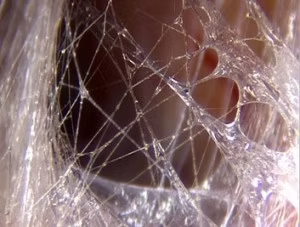
*Click the image to see “Strolling Under the Skin”*
Explore your curiosity and schedule an integrated MFR session with me.
 Blisstaysis
Leave a comment